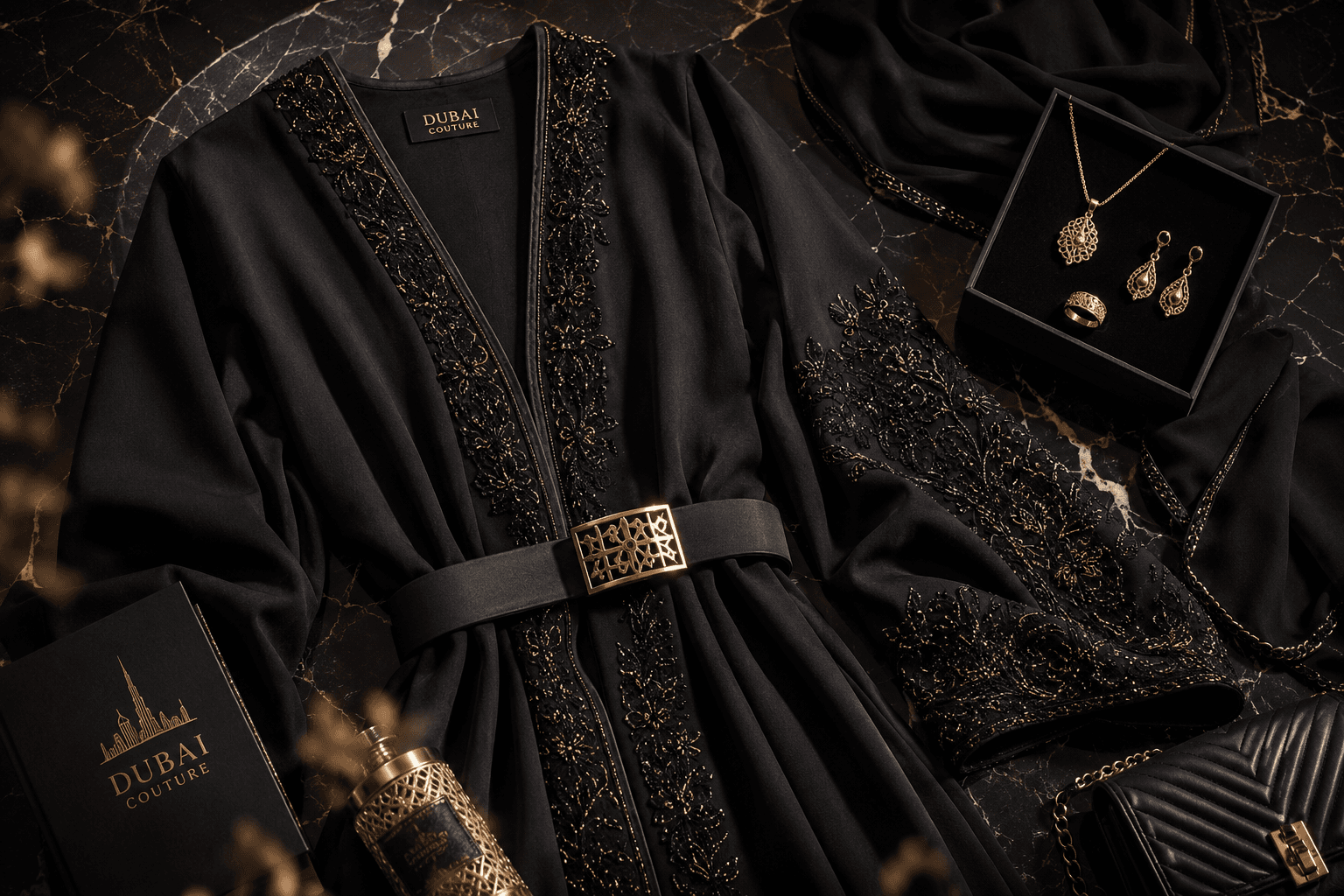
The Complete Abaya Guide — Fabrics, Styles and How to Choose the Perfect One
The abaya has travelled far from its origins as a simple modest garment. Today it is a canvas for some of the most sophisticated craftsmanship in the fashion world — embroidery, stonework, rare fabrics, bespoke tailoring. This guide helps every woman navigate this rich universe with confidence and elegance.
The Abaya — From Tradition to High Fashion
The abaya originates from the Arabian Peninsula, where it served as modest daily dress for women across the Gulf region for centuries. What began as a simple black garment has evolved into one of the most dynamic categories in global modest fashion — with designers from Dubai, Riyadh, Kuwait and beyond creating pieces that rival the finest European couture in craftsmanship and creativity.
Today's abaya is not a uniform. It is an expression of identity, culture and personal style — one that accommodates every taste from the purist to the avant-garde.
Choosing Your Fabric — The Complete Guide
The fabric is the most critical decision in choosing an abaya. It determines comfort, drape, appearance and longevity.
| Fabric | Texture | Appearance | Best For | Season |
|---|---|---|---|---|
| Nida | Soft, lightweight | Matte with subtle sheen | Luxury everyday, formal | All year |
| Crepe | Flowing, slightly textured | Matte, elegant drape | Casual and formal | All year |
| Viscose | Soft, fluid | Slight sheen | Breathable casual/formal | Summer |
| Chiffon | Light, sheer | Translucent, delicate | Layered, formal | Summer |
| Jacquard | Textured with woven patterns | Rich, decorative | Special occasions | Autumn/Winter |
| Linen | Crisp, cool | Matte, natural | Casual summer | Summer |
| Cotton | Soft, breathable | Matte | Everyday, casual | Summer |
| Velvet | Plush, soft | Rich, lustrous | Evening, celebrations | Autumn/Winter |
| Satin Silk | Smooth, glossy | Shiny, luxurious | Evening, high-end | Autumn/Winter |
Nida is the undisputed queen of Gulf abayas. Developed specifically for the region's climate and aesthetic, it combines the softness of silk with the modesty of matte finish. It drapes beautifully without clinging and maintains its shape through long days in air conditioning and outdoor warmth.
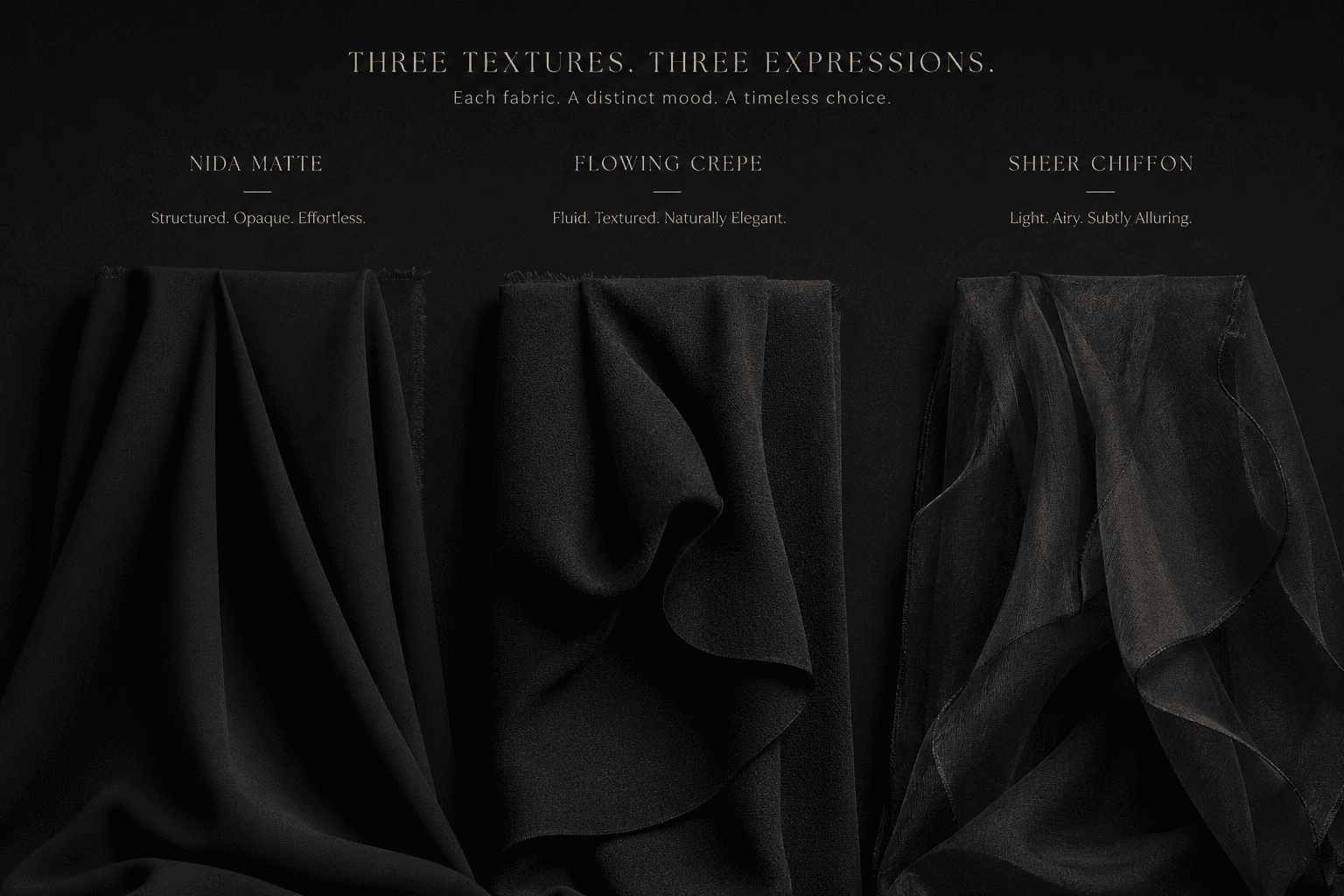
Nida, crepe and chiffon — the three essential fabrics of Gulf abaya culture
Choosing Your Style — By Body Shape
Understanding how different abaya cuts work with your body shape transforms the experience from functional to truly flattering.
Pear Shape — Narrow shoulders, wider hips
Choose abayas with embellishments, details or patterns around the neckline and shoulders. This draws the eye upward and creates visual balance. A-line cuts that flow away from the hips without cinching are ideal. Avoid heavy detailing at the hem or hip level.
Apple Shape — Wider waistline, narrower shoulders and hips
Opt for flowing, loose-fitting abayas that do not cling to the waist area. Wide sleeves or embellishments at the neckline create upward visual movement. Empire waist cuts that fall straight from just below the bust are particularly flattering. Avoid belted styles that draw attention to the midsection.
Athletic Shape — Broader shoulders, narrower hips
A-line cuts or flared bottoms create visual curves and balance broader shoulders. Details around the waist or lower body add dimension. Avoid very structured shoulders or heavy embellishments across the upper body.
Rectangle Shape — Balanced measurements with minimal waist definition
Waist details — a belt, pleating or a seam at the natural waist — create the illusion of curves. Flared styles that add volume at the skirt add femininity. Layered designs with different lengths create depth.
Hourglass Shape — Balanced bust and hips with defined waist
The abaya world is your playground. Belted styles, fitted bodices with flared skirts, and wrap-inspired cuts all beautifully enhance natural curves. Ensure the abaya is not too loose at the waist — the definition is your asset.
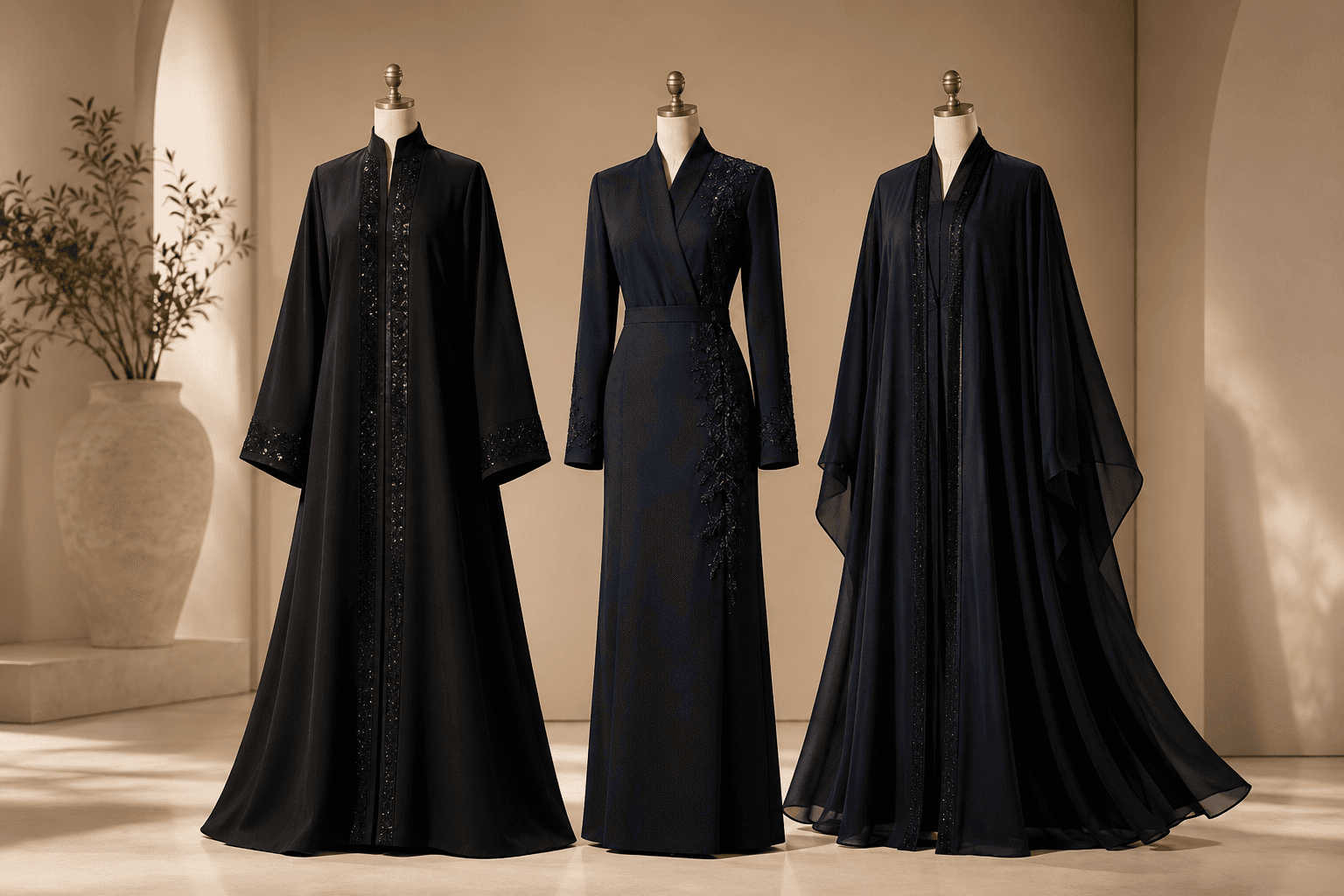
Every body shape has its perfect abaya — the key is knowing what to look for
The Most Iconic Abaya Styles
The Black Classic Abaya The foundation of the Gulf wardrobe. Simple, fluid, timeless. Made in lightweight crepe or Nida for hot climates. Some feature subtle embellishments — a line of lace, small stones at the cuffs — that elevate without overwhelming. The black abaya is the uniform of understated elegance.
The Embroidery Abaya Hand or machine embroidery in floral, geometric or calligraphic patterns — often reflecting local artistic traditions. Light satin, silk or crepe base fabrics. Ideal for weddings, formal gatherings and religious holidays. Often paired with matching embroidered accessories.
The Stone Abaya Crystals, stones or beads intricately placed along necklines, cuffs or hems. Ranges from subtle single-crystal details to full crystal embellishment for maximum impact. The stone abaya is the choice for celebrations, formal events and evenings where presence matters.
The Coloured Abaya The modern Gulf woman has embraced colour with confidence. Navy, forest green, dusty rose, camel — colours that complement skin tones while maintaining modesty. The coloured abaya requires a more considered approach to accessories: neutrals complement, prints compete.
The Open Abaya Worn over a coordinated inner outfit rather than as a standalone garment. More casual and versatile — can be styled differently each time. Popular in Kuwait and the UAE for everyday wear.
Custom-Made vs Ready-to-Wear
Ready-to-wear offers convenience, immediate availability and price accessibility. The challenge: standard sizes rarely accommodate the full range of body proportions perfectly.
Custom-made offers perfect fit, complete creative freedom and true individuality. Investment is higher but justified for special occasions or if you wear an abaya daily. The most respected abaya houses in Dubai and Riyadh offer bespoke services with fabric selection, embellishment choice and precise measurement.
Abaya Care — Preserving Your Investment
Washing by fabric type:
- Nida, crepe, chiffon: hand-wash in cold water with mild detergent. Never wring or scrub.
- Cotton, linen: gentle machine cycle cold, inside out.
- Velvet, satin silk, heavily embellished: dry clean only.
Drying: Never tumble dry. Hang on padded hanger away from direct sunlight. Lay chiffon and satin flat on a clean towel.
Ironing: Steam iron on lowest setting for delicate fabrics. Never iron directly over embellishments, stones or embroidery. Use a pressing cloth.
Storage: Padded hanger inside a garment cover. Keep away from direct sunlight to prevent colour fading. For heavily embellished pieces: fold in acid-free tissue and store flat in a box.
Perfume tip: Never spray perfume directly onto an abaya fabric. Apply to your wrists and neck before dressing. Oil-based attars are safer than alcohol-based fragrances for delicate fabrics.
Frequently asked questions
Nida is the top choice — lightweight, breathable, drapes beautifully without clinging. Crepe is an excellent alternative. Both maintain their shape in air conditioning while feeling light outdoors. Avoid velvet and heavy jacquard in summer — they retain heat significantly.
Four key measurements: bust (widest point), waist (natural waist), hips (widest point), and length (shoulder to desired hem). For online shopping, length is the most critical — it varies significantly by height. Most quality abayas offer height-adjusted lengths or customisation.
Absolutely. In the UAE and Gulf countries, abayas are worn by women of all faiths — both as a cultural courtesy in certain spaces and as a fashion choice. The global modest fashion movement has also made the abaya a respected style choice worldwide regardless of faith.
The black abaya is extraordinarily versatile. Gold jewellery (the Gulf classic), a statement watch, embellished sandals or heels, a structured handbag. The abaya's simplicity makes it the perfect backdrop for accessories to shine.
For everyday crepe or Nida abayas: hand-wash every 2-3 wears. For embellished pieces: dry clean after every 3-5 wears, or when visibly soiled. Never delay cleaning if perfume or food has touched the fabric — it sets permanently.
Dubai abayas tend toward contemporary luxury — more colour, more creative embellishment, open-front styles. Saudi abayas traditionally favour classic black with elegant restraint, though this is evolving rapidly. Kuwaiti abayas often feature lighter fabrics and more detailed embroidery reflecting the country's pearl-diving heritage aesthetic.
Generally yes — coloured abayas are widely accepted throughout the Gulf. Conservative settings (certain mosques, very traditional communities) may culturally favour black. As a visitor or in professional settings, when in doubt, classic black is always appropriate and respected.
Choose clean lines, minimal embellishment, Nida or crepe fabric. A structured abaya with simple cuffs and a modest collar reads professionally. Pair with a quality leather handbag, closed-toe heels or flats and understated jewellery. Avoid heavily embellished or casual open-front styles in formal professional contexts.
Ready-to-wear quality abayas range from AED 300 to AED 1,500 for premium everyday pieces. Designer and embellished abayas start from AED 2,000 and reach AED 5,000+ for couture pieces. Custom-made abayas vary widely depending on fabric, embellishment and maker's reputation.
Verify the retailer's size guide against your measurements — length especially. Check fabric description carefully (not just the name). Look for detailed photos showing drape and movement. Prioritise retailers with clear return policies. Read reviews specifically mentioning fit and fabric feel rather than just aesthetic appreciation.